Legacy Lock was born in the gap between what families are told to do on paper and what actually happens in real life.
After decades of working with families through retirement, illness, and life transitions, Joe saw a pattern most people are not prepared for: the greatest risks to a family’s legacy often do not begin at death. They begin earlier, in the quiet phase of aging, when judgment may be changing but legal authority has not yet shifted. That is the gap his work was built to close.
He watched families come in with documents but without clarity.
He watched trustees be named without being prepared.
He watched assets sit outside the trust because no one had aligned them properly.
He watched families carry unanswered questions at exactly the moment they needed confidence.
And too often, he watched people who loved each other get pushed into confusion, conflict, delay, and decisions no one ever meant to create.
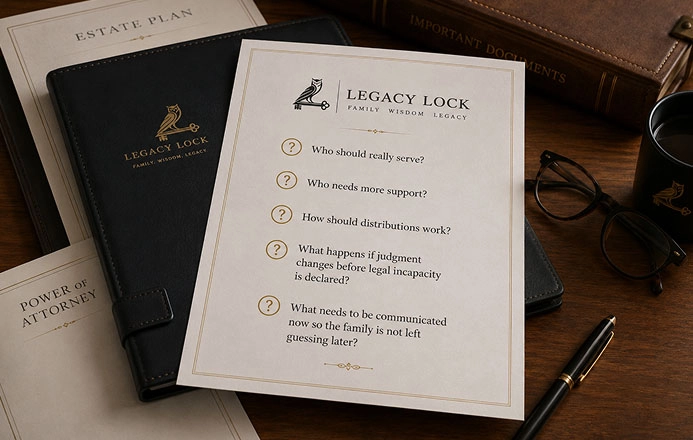
Traditional estate planning often asks very specific questions and records very specific answers. But many of the most important legacy questions are never fully explored: Who should really serve? Who needs more support? How should distributions work? What happens if judgment changes before legal incapacity is declared? What needs to be communicated now so the family is not left guessing later? Your own strategy materials make this distinction directly: Legacy planning is framed as preparation for living, while estate planning is often framed as preparation for dying.
That is why Joe says estate planning can feel like a minimalist checklist at best.
Not because the documents do not matter.
Because the documents are often only the beginning.
Legacy Lock is about protecting financial dignity, preserving independence, and helping families prepare thoughtfully before crisis forces difficult decisions. The Creative Clarity materials say that clearly, and they also make another point Joe feels deeply: financial dignity is not defined by the size of someone’s assets. What matters is that the money is important to them, that it reflects a lifetime of work and sacrifice, and that their wishes are carried out with care.
Sometimes the harm happens before death, through loneliness, poor judgment, manipulation, pressure, or the absence of thoughtful guardrails.
Sometimes it happens after death, through probate, unclear trustee roles, poor distribution design, missing asset alignment, or institutions that will not act when the instructions are not clear enough.

Joe had already spent years helping families think through retirement, taxes, investments, gifting, and legacy decisions. But again and again, families would arrive needing help at the exact moment the structure around them was weakest. The documents had not anticipated real life. The trust was not written for what the family was actually facing. The right professionals were not in place. The right people had not been prepared. And because of that, the very outcomes the person would have wanted most were suddenly much harder to protect.
Legacy Lock came from taking that problem seriously.
It came from wanting families to have better questions before documents are written.
That is why Aging With Clarity provides the education and awareness, and Legacy Lock translates that awareness into structure.
This work is not about taking control away from families.
It is about helping them hold onto clarity longer.
It is about building thoughtful guardrails while people still have a voice.
It is about making sure love, money, responsibility, and communication are not left to chance.
Legacy Lock exists to help families prepare early, protect financial dignity, and preserve the relationships that matter most. That is the through-line in your core materials, and it is the clearest expression of why this brand now exists.